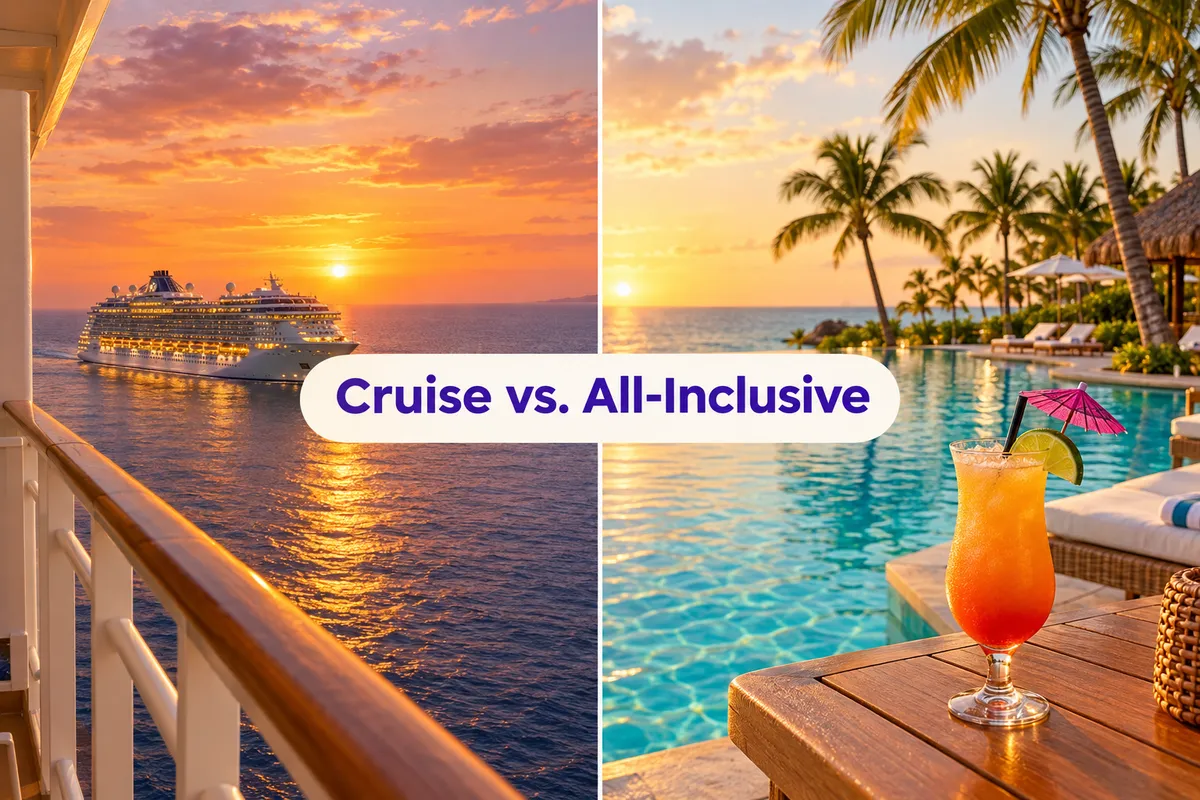
Cruise vs. All-Inclusive Resort: Which Vacation Is Right for You?
Cruise vs. All-Inclusive Resort
Quick answer: Choose a cruise if you want to see several destinations in one trip and have plenty to do every day. Choose an all-inclusive resort if you want to unpack once, stay in one beautiful spot, and know your total cost upfront. Both give you sun, great food, and a real break from daily life. The right pick depends on how you like to rest.
I get this question almost every week. A client says, "I want a beach, a drink in my hand, and zero decisions. Should I book a cruise or an all-inclusive?"
I first cruised in 2013, and it felt like a full life reset. Since then, I've planned both kinds of vacations as a Certified Cruise Counsellor and Certified Travel Associate. My honest answer is that neither one wins every time. Here is how I help my clients choose.
How Are Cruises and All-Inclusive Resorts Similar?
They solve the same problem. You want a vacation that is already planned for you, so you can stop managing and start relaxing. Here is what they share:
Food is built in. You are not hunting for dinner reservations or checking a menu price every night.
Entertainment is on site. Pools, live music, shows, games, and activities are steps from your room.
Planning is simpler than a DIY trip. Your room, meals, and activities are bundled in one place instead of five.
You can unplug. Both are made for leaving work, errands, and the group chat behind.
Both work well for groups. Birthdays, girls' trips, reunions, and friend getaways run smoothly on either one.
How Do They Differ?
Here is the side-by-side I walk my clients through.
Category | Cruise | All-Inclusive Resort |
|---|---|---|
Destinations | Several ports in one trip, one unpack | One location, deeper stay |
What the base price covers | Cabin, most meals, entertainment, kids' programs, pool use | Room, meals, drinks including alcohol, activities, often tips |
Common extras | Alcohol, soda, specialty dining, Wi-Fi, gratuities, excursions, spa | Spa, motorized water sports, off-property tours |
Room size | Smaller cabins | Usually larger rooms and suites |
Pace | Busy and full of options | Slower and more flexible |
Beach time | Limited to port days | Unlimited |
Crowds | Thousands of guests on a large ship | Often fewer guests and more space |
Hurricane season | Ships can change route to avoid storms | A resort cannot move |
Cost clarity | Final bill depends on your onboard spending | Total is mostly known before you go |
1. Where you wake up
On a cruise, you could wake up in a new port every morning. Your hotel moves while you sleep, with no repacking and no transfers. At a resort, you wake up in the same place every day. For many people that is the whole point. Others get restless after three days.
2. What is actually included
Many travelers think "cruise" means "all-inclusive." Usually it doesn't. A standard cruise fare covers your cabin, meals in the main dining room and buffet, pool use, entertainment and kids' programs. You typically pay extra for alcohol, soda, specialty coffee, specialty restaurants, gratuities, Wi-Fi and shore excursions.
At an all-inclusive resort, the room rate generally covers meals at the resort restaurants, drinks including alcohol, beach and pool access, and most activities. Tips are often included too. Spa treatments, motorized water sports and off-property excursions are the usual extras.
Some cruise lines, especially luxury and smaller-ship lines, bundle much more into the fare. Mass-market lines sometimes run sales that add drinks or Wi-Fi. Always read the fine print on what the "all-inclusive" offer really covers.
3. The real price
This is where I help clients most, because the advertised price can mislead you.
One published example shows how fast cruise extras add up. A 7-night Caribbean cruise for two with an interior cabin at $1,200 per person starts at $2,400. Add a drink package at roughly $80 to $100 per person per day, gratuities around $18 to $20 per person per day, Wi-Fi and a few shore excursions. The total climbs to roughly $5,000 for two. That same source puts a mid-range 4-star all-inclusive resort in Mexico or the Caribbean at roughly $3,100 to $3,400 for two for the same week. (Note that the source is a resort booking site, so treat the comparison as one data point.)
The numbers can also swing the other way. A Royal Caribbean writer who tried a luxury resort after 30 cruises noted that high-end resort rooms can run $950 to $1,500 per night, compared with a typical cruise averaging $200 to $300 per night for two.
Here is what usually tips the scale:
Cruises tend to cost less when you don't drink much, you sail longer than a week, or you can drive to a port like Miami, Fort Lauderdale or Port Canaveral and skip airfare.
Resorts tend to cost less when you enjoy cocktails, you want predictable pricing, or you would otherwise buy drink packages, Wi-Fi and dining add-ons on a ship.
My rule is to compare the full cost, not the starting price. I do that math for every client before they book.
4. Activities and energy
Newer cruise ships have water parks, mini golf, rock climbing walls, comedy shows and Broadway-style productions. It takes effort to be bored. Resorts offer pools, beaches, nonmotorized water sports and live entertainment, but with less nightlife variety. Some travelers love the quiet. A few tell me the evenings felt slow.
5. Space and crowds
Resort rooms are almost always bigger than cruise cabins. Resorts also tend to be less crowded than a large ship. If you are a couple craving privacy, this matters. If you love a lively atmosphere and meeting people, a ship delivers that.
6. Weather risk
During hurricane season (June through November), a ship can change course to avoid a storm. A resort stays put. This is not a reason to avoid resorts. It is a reason to book with an advisor, buy the right travel protection and understand your options.
Who Should Choose a Cruise?
A cruise is likely your best fit if you:
Want to sample several destinations in one trip
Love a full schedule with shows, activities and dining variety
Are traveling with kids ages 8 to 15 who enjoy kids' clubs and teen spaces
Are a solo traveler who wants built-in community and easy ways to meet people
Are planning a multigenerational trip where everyone wants something different
Are a first-time traveler who wants a simple, structured way to see a few places
Want to keep your trip close to home by driving to a U.S. departure port
Fun fact: if you are a U.S. citizen on a closed-loop cruise that starts and ends at the same U.S. port, you may not need a passport book. A passport is still strongly recommended in case plans change.
Who Should Choose an All-Inclusive Resort?
A resort is likely your best fit if you:
Want to unpack once and truly do nothing
Care most about beach and pool time
Prefer predictable budgeting with fewer surprises
Enjoy cocktails and want them included
Are traveling with toddlers and need space and flexible schedules
Are planning a romantic getaway or honeymoon and want privacy
Prefer a quiet, slower pace over a packed itinerary
Want to dive deeper into one destination instead of touring several
A Quick Gut Check
Ask yourself these three questions:
Do I want to explore or to exhale? Explore leans cruise. Exhale leans resort.
How much do I want to think about money once I'm there? Zero leans resort. A little flexibility leans cruise.
Do I want a lively scene or a peaceful one? Lively leans cruise. Peaceful leans resort.
Why Work With a Travel Advisor on This Decision
Comparing a cruise to a resort is tricky because they price things so differently. I help my clients by:
Building a true total cost for both options, including flights, drinks, tips and excursions
Matching the right ship or resort to your travel style, comfort level and group
Finding perks and bonuses that aren't always visible when you book on your own
Being your one point of contact before, during and after your trip
You don't have to figure this out alone. In a free consultation, I'll ask a few questions, compare two or three options side by side and help you choose with confidence.
Frequently Asked Questions
Are cruises all-inclusive? Most mainstream cruises are not fully all-inclusive. Your fare covers your cabin, most meals and entertainment. Alcohol, specialty dining, Wi-Fi, gratuities and excursions are usually extra unless you add a package or sail on a line that includes them.
Is a cruise or an all-inclusive resort cheaper? It depends on how you spend. If you drink, dine at specialty restaurants and book excursions, a cruise can cost as much as or more than a mid-range resort. Non-drinkers, longer sailings and drive-to-port travelers often find cruises cost less.
Which is better for families? Families with kids ages 8 to 15 often love cruises for the kids' clubs and variety. Families with toddlers often prefer resorts for the space and flexible schedules.
Which is better for solo travelers? Cruises are often easier for solo travelers who want built-in social opportunities. Some resorts also welcome solos, especially adults-only properties, so it depends on your comfort level.
Which is safer during hurricane season? Ships can adjust their routes around storms, while a resort cannot move. Whichever you choose, travel protection and flexible booking policies are worth discussing with your advisor.
Do I need a passport for a cruise? For U.S. citizens, closed-loop cruises that begin and end at the same U.S. port may not require a passport book, but I always recommend one. Resorts in Mexico and the Caribbean require a valid passport.
Ready to Decide?
If you are torn between a cruise and an all-inclusive resort, let's talk it through. Book a free travel consultation and I'll compare real options, real totals and real perks so you can book the trip that fits you.
Comment CRUISE or RESORT below, or book your free consultation through the link on my site.
Pricing and availability change daily and vary by supplier, sailing date and resort. Please verify current rates before booking.


